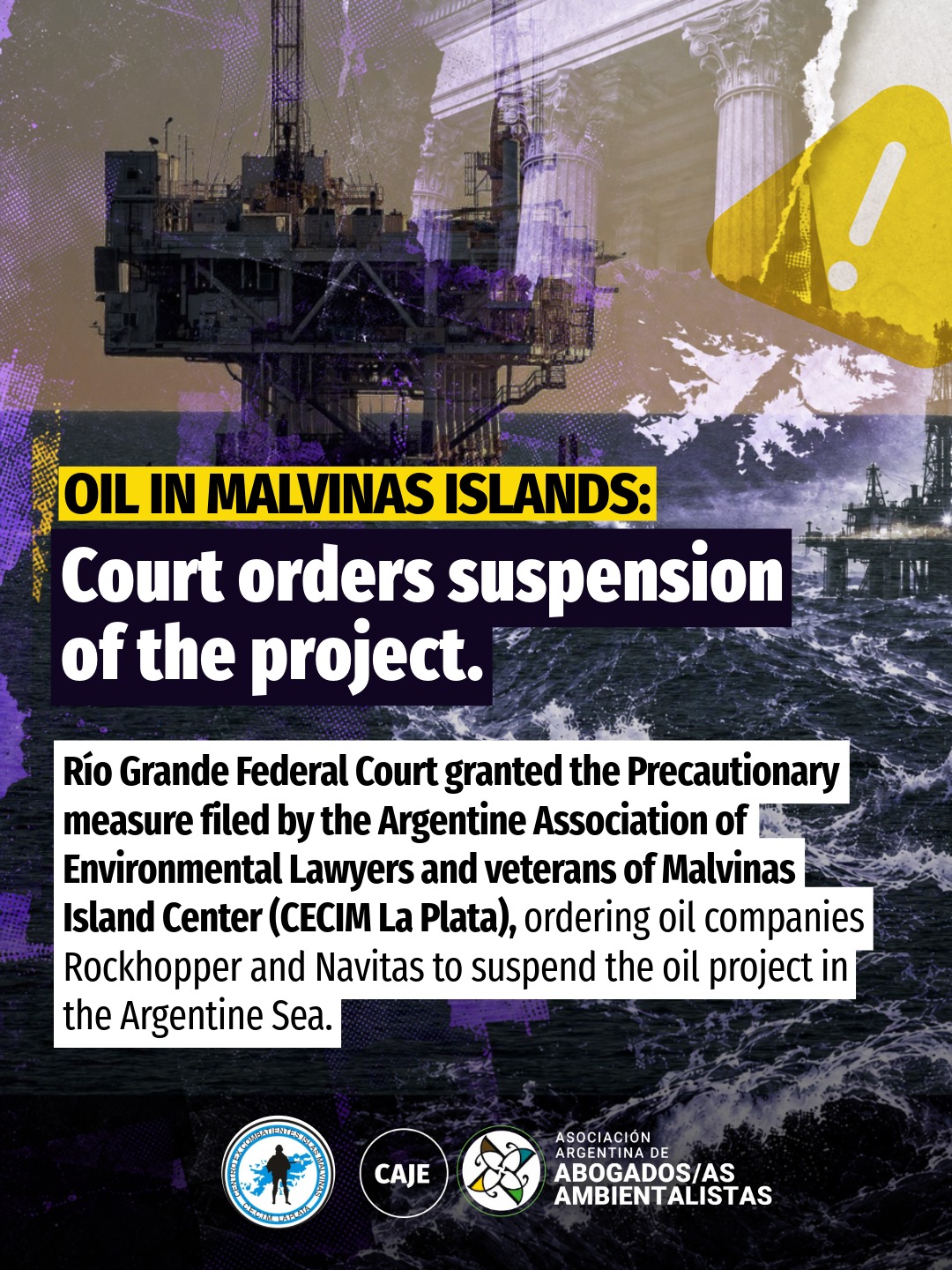
The project aims to install a large-scale oil extraction operation on the Argentine continental shelf, 220 kilometers from the Malvinas Islands. We request that the Federal Judiciary suspend the works and their financing. The Argentine Sea is at risk. So too is sovereignty.
From the Argentine Association of Environmental Lawyers (AAdeAA) and the Malvinas Islands La Plata Ex-Combatants Center (CECIM), we are filing a preventive action against collective environmental damage against Rockhopper Exploration, a British company, and Navitas Petroleum Development, an Israeli company.
The lawsuit seeks to halt the Sea Lion oil and gas project, referred to as “León Marino” in the legal filing. The companies are advancing in the North Malvinas Basin without the environmental impact assessment required by Argentine legislation or authorization from national authorities. The filing also incorporates a decisive dimension: the project introduces a unilateral modification over a territory, which clearly violates United Nations Resolution 31/49.
The action was filed before the Federal Court of Río Grande, which has jurisdiction over Tierra del Fuego, Antarctica, and the South Atlantic Islands. We demand the immediate suspension of the works and of the financial operations destined for the project.
AAdeAA and CECIM come from different paths that now converge. AAdeAA champions the legal defense of ecosystems, common goods, and access to environmental information. CECIM, born in 1982 and made up of former conscript soldiers, has built over more than four decades a human rights policy for thinking about the Malvinas: Memory, Truth, Justice, Sovereignty, and Peace. Two trajectories. One defense. The lawsuit calls it sovereign environmental protection.
Where the oil project in the Malvinas is located
León Marino is located on the Argentine continental shelf, approximately 220 kilometers north of the Malvinas Islands, in the blocks identified by the companies as PL032 and PL004b.
Map of the project, 220 kilometers north of the Malvinas Islands.
The infrastructure is distributed between the North Malvinas Basin and the islands. The logistics center would be located in Puerto Argentino, with port expansions, warehouses, housing, and plants for fuels, chemicals, and drilling muds.
The first two phases contemplate 23 subsea wells: 16 producers, six water injectors, and one gas well. They include pipelines, seabed equipment, and a floating production, storage, and offloading unit.
Navitas reports that the first stage comprises 11 wells and the second, another 12. It projects production from 2028 for over 30 years. The company itself locates the field 220 kilometers north of the islands.
During 2026, work began on the dock and onshore base. The companies also advanced in the manufacturing of equipment and the adaptation of the floating unit that would operate in the field. Drilling is scheduled for early 2027. First extraction, for the first half of 2028. Rockhopper publicly reported the start of these works.
In January 2026, AAdeAA submitted requests for public information access to the Chief of the Cabinet of Ministers and the Ministry of Economy. The official responses confirmed a central fact: Rockhopper and Navitas did not make the mandatory submissions to explore or exploit hydrocarbons. Nor did they initiate an environmental impact assessment procedure before the Argentine State.
Prior assessment allows for understanding risks, demanding independent studies, analyzing alternatives, and guaranteeing citizen participation. None of that occurred before Argentine authorities. Licenses from the British colonial administration do not replace our laws nor allow lawful disposal of the natural assets of the Argentine continental shelf.
Rockhopper was declared clandestine in 2012 and disqualified from operating in Argentina for 20 years. Navitas received equivalent sanctions in 2022. In December 2025, the Ministry of Foreign Affairs rejected the investment announced by both companies: it lacks authorization and contradicts United Nations resolutions on the dispute. The official communiqué reaffirms the sanctions and the Argentine position.
Sovereignty as a collective legal asset
The First Transitional Provision of the National Constitution ratifies the legitimate and imprescriptible sovereignty over the Malvinas, South Georgia, and South Sandwich Islands and their maritime and insular spaces. It recognizes them as an integral part of the national territory. It places their recovery and the full exercise of sovereignty as a permanent and unrenounceable objective of the Argentine people.
Each word carries legal weight. The Constitution ratifies a title, integrates those spaces into the territory, and places the mandate upon the people. The constitutional text obliges all powers of the State.
The Federal Judiciary has already recognized, in CECIM’s action in defense of the Land Law, that national sovereignty is a collective and indivisible asset. There is no sovereignty in quotas. A partial injury damages the whole. CECIM’s bylaws mandate protecting sovereign rights in the South Atlantic, defending human rights, and honoring the memory of those who fell.
Sovereignty exceeds the map and the commemoration. It encompasses the people’s right to decide, the right of families that the place where their dead lie not be contaminated, and the right of future generations to receive a living heritage. Each well sinks a claim of colonial permanence.
On the same space, two collective assets overlap: environment and sovereignty. The harm arises from a large-scale hydrocarbon project, executed without Argentine assessment or authorization. The wound is double. It affects ecosystems. It affects the people’s right to decide and preserve what is their own.
The ecosystems of the Argentine Sea that are threatened
The project directly affects two ecoregions recognized by Argentina: the Argentine Sea and the South Atlantic Islands. Its area of influence also maintains an ecological connection with Antarctica.
The Argentine Sea ecoregion comprises the waters of the continental shelf and supports enormous biological productivity. There live, reproduce, or feed around 300 species of fish, as well as southern right whales, sea lions and elephant seals, Magellanic penguins, albatrosses, petrels, cormorants, orcas, dolphins, sharks, and rays.
The works entail drilling, seabed movement, vessels, underwater noise, chemicals, and risk of spills. Currents can extend their effects over feeding, breeding, and migration areas between the Argentine Sea, the South Atlantic Islands, and Antarctica.
The facilities in Puerto Argentino add terrestrial and coastal impacts: port expansion, storage of fuels and chemicals, waste generation, increased traffic, and construction of industrial infrastructure. The sea and the coast form a single extractive system. They must be assessed as such.
What we are asking of the Judiciary
The precautionary measure requests suspending the works, drilling, and seabed movements. Also preventing new contracts, disbursements, transfers, or guarantees destined for the project. It seeks to halt the environmental and sovereign risk before the damage occurs. And the unilateral modification before the fait accompli.
We request that the case be notified to financial oversight bodies and the markets where the companies operate. That the companies identify banks, funds, insurers, and other actors supporting the exploitation. Money leaves traces. Those who finance an illegal activity cannot remain behind the corporate fog.
We request that licenses from the British colonial administration be declared unenforceable against the Argentine Republic. A colonial authorization does not turn dispossession into a right nor substitute the assessment, citizen participation, and permits required by Argentine environmental public order.
This filing continues AAdeAA’s trajectory against the oil frontier. In 2022, together with organizations and assemblies, it promoted an action against offshore exploration off Mar del Plata. The case obtained a precautionary measure and set a precedent on cumulative impacts. Today that experience converges with CECIM’s sovereign and human rights trajectory.
Resolution 2065 recognized the sovereignty dispute and opened the path to negotiation. In 1976, UN General Assembly Resolution 31/49 urged Argentina and the United Kingdom to refrain from adopting decisions that introduce unilateral modifications while the controversy remains open. León Marino violates that mandate. Infrastructure. Capital. Thirty years of extraction projected over a disputed territory. Each well seeks to also drill through the law. Oil appears as a new form of the old dispossession.
Faced with the start of works, intervention must be immediate. Prevention works before the scar. After a spill, the damage is largely irreversible. After decades, the fait accompli tries to become part of the landscape.
Defending the Malvinas requires peace. Requires law. Requires care. Memory, Truth, Justice, Sovereignty, and Peace form a single fabric. The sea is territory. The environment is heritage. Sovereignty belongs to the people.
Press contacts
Argentine Association of Environmental Lawyers (AAdeAA): Enrique Viale, +54 9 11 5120-7518.
About the companies: sanctioned in Argentina
Rockhopper Exploration is a British oil company, incorporated in England and Wales, headquartered in Salisbury, and listed on the AIM market of the London Stock Exchange. In Argentina, it was declared clandestine in 2012 for developing hydrocarbon activities on the continental shelf without national authorization. In 2013, the Secretariat of Energy disqualified it for 20 years. Despite those sanctions, it retains 35% of the León Marino project. Rockhopper corporate information. Disqualification resolution.
Navitas Petroleum is an Israeli oil company, headquartered in Israel and listed on the Tel Aviv Stock Exchange. It controls 65% of the project through Navitas Petroleum Development and Production Limited, a subsidiary incorporated in the United Kingdom. The Argentine State formally warned it to refrain from financing and participating in unauthorized oil activities around the Malvinas. The company continued: in 2022 it was declared clandestine and disqualified for 20 years. Official information on the sanction.