
In the province of Neuquén, Primary School No. 291, located in Aguada Toledo within the Loma La Lata–Sierra Barrosa area, was closed due to pollution. The school community is being relocated without adequate information. After two months without classes, the Provincial Council of Education decided to keep the building closed until the end of February, while YPF is required to carry out a remediation plan. Just 1,100 meters from the school is one of the world’s most significant methane emission sources, according to monitoring conducted by the United Nations Environment Programme’s International Methane Emissions Observatory (UNEP-IMEO).
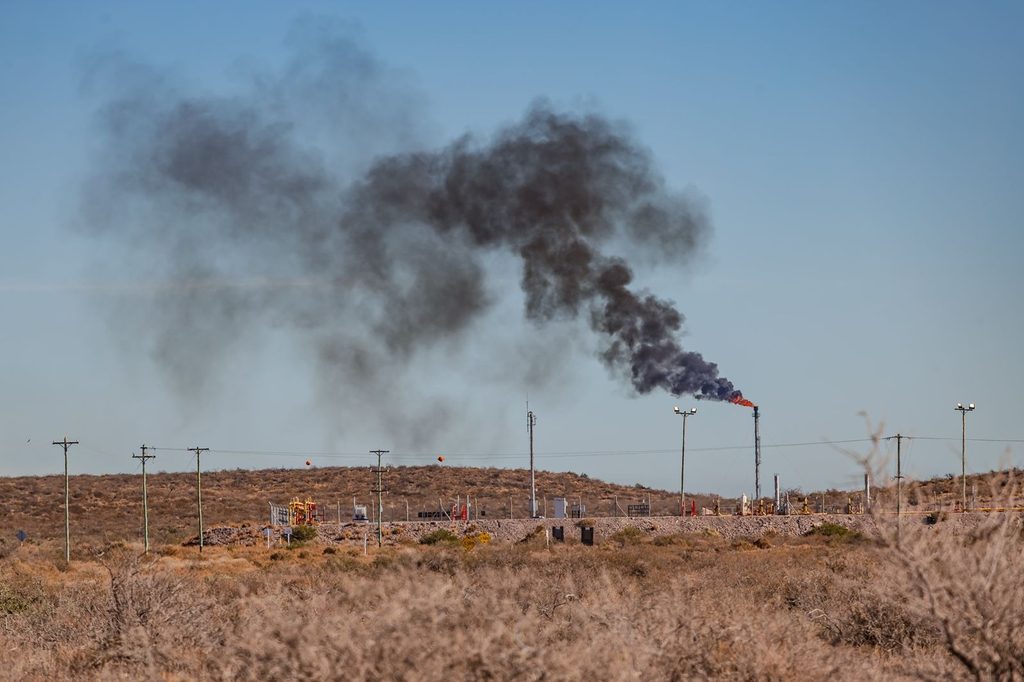
Photo: Martín Álvarez Mullally
By Leonora Jáuregui Nicolet (OPSur) and María Marta Di Paola (AAdeAA/CAJE)
Aguada Toledo Primary School No. 291 has been closed since the end of the winter break, almost two months ago. The return to school coincided with a storm that made access difficult along an already badly deteriorated section of road. Heavy truck traffic had carved out a deep rut that fills with water when it rains, making it impossible for the school transport service to pass safely. On August 18, once access conditions had improved, the school building was left without gas.
Janet Alveal is the principal of this rural school, which belongs to School District II of Cutral Có and Plaza Huincul. During these weeks, Alveal issued a statement describing the situation and calling for an institutional response: “This lack of gas service affects the daily operation of a full-day school, which is why the corresponding steps have been taken in an effort to find a solution.”
For almost two months, the only explanation given by the Provincial Council of Education was that there were leaks at the school because gas was being consumed too quickly. The Aguada Toledo school community made a series of public demands together with the Neuquén Education Workers’ Association (ATEN), eventually securing a meeting with Education Minister Soledad Martínez at the Council’s headquarters in the city of Neuquén.
On Monday, September 21, after ten weeks without classes, the provincial education authority met with the school community and informed them that the school would remain closed until the end of February because of environmental health concerns that she chose not to explain. She also announced that classes would be relocated to Challacó, 30 kilometers farther away along an unpaved road that is routinely in poor condition.
On Friday, September 25, school authorities received an internal communication between provincial education officials informing them that the school would be temporarily closed from October of this year through February of next year. The closure was ordered “in connection with the proceedings carried out by the Secretariat of Environment and Natural Resources regarding the environmental situation in the vicinity of Aguada Toledo Primary School No. 291,” with the stated purpose of protecting the school community while YPF carries out mitigation work. According to the document, the Secretariat of Environment assigned YPF responsibility for conducting the air-quality study and monitoring, effectively delegating technical and socio-environmental responsibility to the private company.
The Gases of Vaca Muerta
According to a report published in June 2026 by the United Nations Environment Programme’s International Methane Emissions Observatory (UNEP-IMEO), Argentina ranked 49th because of leaks from storage tanks located at coordinates -38.76047, -68.83698 in Neuquén. These are YPF tanks located in Sierra Barrosa. According to the Observatory’s Eye on Methane platform, the leak was continuously detected by satellite over the course of a year, between May 2025 and May 2026.
In early August, the Argentine Association of Environmental Lawyers and the Collective for Action on Ecosocial Justice (AAdeAA-CAJE) submitted a request for access to public environmental information, alerting Neuquén’s Secretariat of Environment and Natural Resources to the situation. The request specifically asked what containment measures had been taken regarding the leaks near the school.
In its response, the Secretariat of Environment stated that provincial officials had inspected the school and found it closed, but nevertheless carried out measurements. They reported no problems related to emissions from nearby flares. However, Patricia Rodriguez, a methane measurement specialist at Earthworks, warned that “the monitor used by representatives of Neuquén’s Secretariat of Environment and Natural Resources during the inspection is an instrument primarily used for occupational and health safety, mostly in enclosed spaces.”
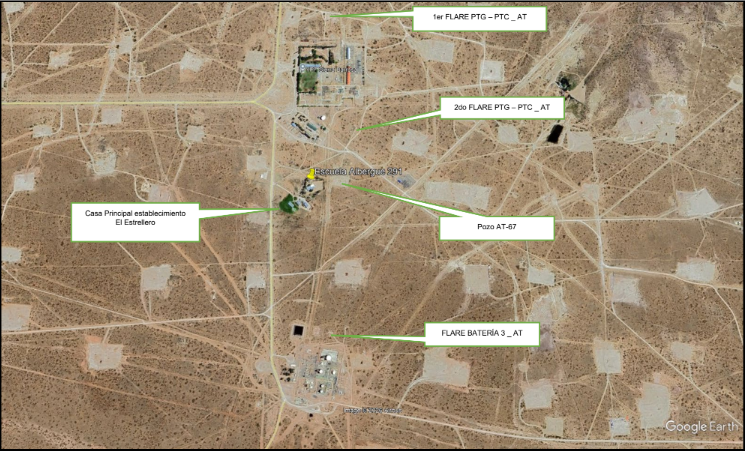
Source: Inspection report by the Secretariat of Environment and Natural Resources
Methane is a colorless and odorless gas and is the second-largest contributor to global warming after carbon dioxide. Specifically, over a 20-year period its global warming potential is 82.5 times greater than that of carbon dioxide.
Hydrocarbon activities emit methane, which contributes to the formation of ground-level ozone, a toxic air pollutant. Methane emissions are also accompanied by other pollutants harmful to health, including nitrogen oxides (NOx), fine particulate matter (PM2.5), hydrogen sulfide (H2S), and BTEX compounds — benzene, toluene, ethylbenzene and xylene — also referred to as secondary pollutants associated with methane emissions.
According to Dr. Luciana Capozzi of the Institute for Socio-Environmental Health (INSSA): “At this school, attended by children from a rural area, their right to live in a healthy territory is being violated. There can be no healthy people when the territories they inhabit are sick. Unconventional hydrocarbon extraction and its by-product — in this case methane — make territories and the bodies that inhabit them sick. When methane contributes to the formation of ground-level ozone, that pollutant can enter the respiratory system and cause inflammation. In children, whose bodies are still developing, this makes them particularly vulnerable to conditions such as rhinitis, asthma flare-ups, dermatitis and blood disorders, among others.”
A School Surrounded by Wells and Emissions
Primary School No. 291 was founded in March 1990 to address barriers to education faced by families living in the Aguada Toledo–La Barrosa area. The school adopted a boarding model to overcome long travel distances, reduce school dropout rates and narrow the gap between rural and urban areas.
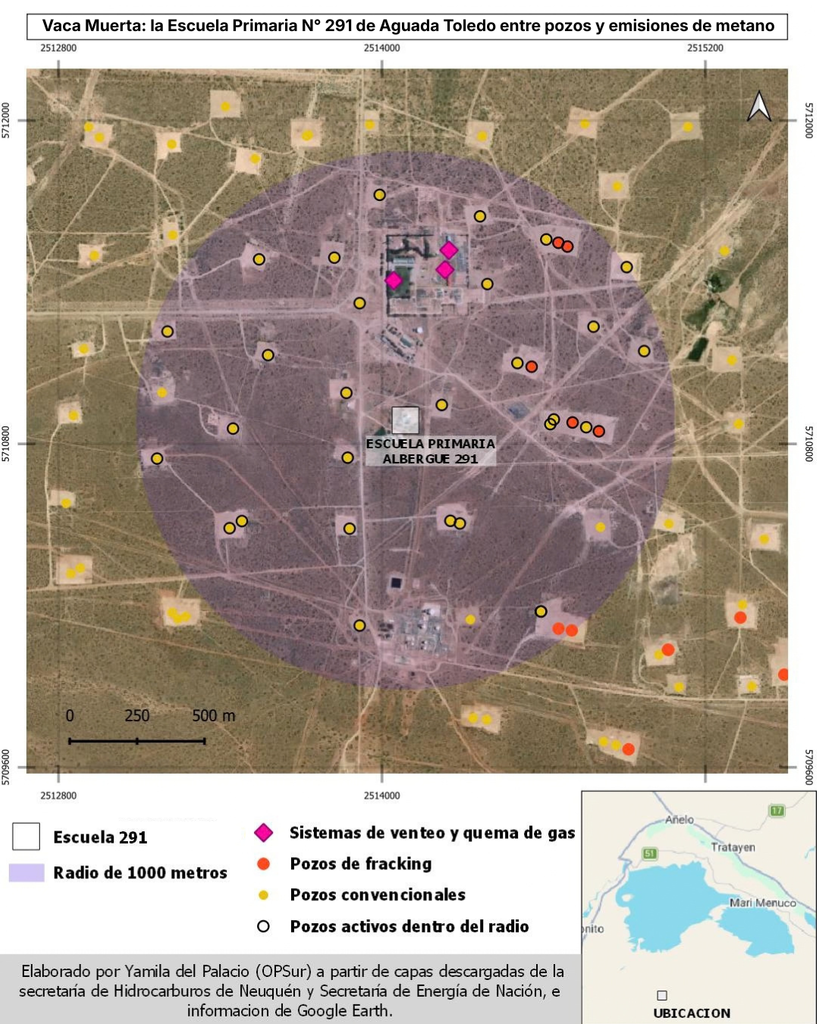
In 2022, the provincial government allocated 92 million pesos to renovate and refurbish the school building. During the six months that the works lasted, there were no classes. However, a lack of funding for student transport later made it impossible to continue the boarding-school model. A little over two years ago, in order to prevent students from repeatedly missing classes because of transportation problems, the school community shifted to an extended-day model.
An Area with Decades of Extraction
The Loma La Lata–Sierra Barrosa hydrocarbon concession covers almost 2,000 square kilometers and includes two fields: Aguada Toledo–Sierra Barrosa and Loma La Lata. According to official provincial information, the Loma La Lata–Sierra Barrosa area has been exploited for more than seventy years and is operated by YPF. Both conventional and unconventional oil and gas are produced there.
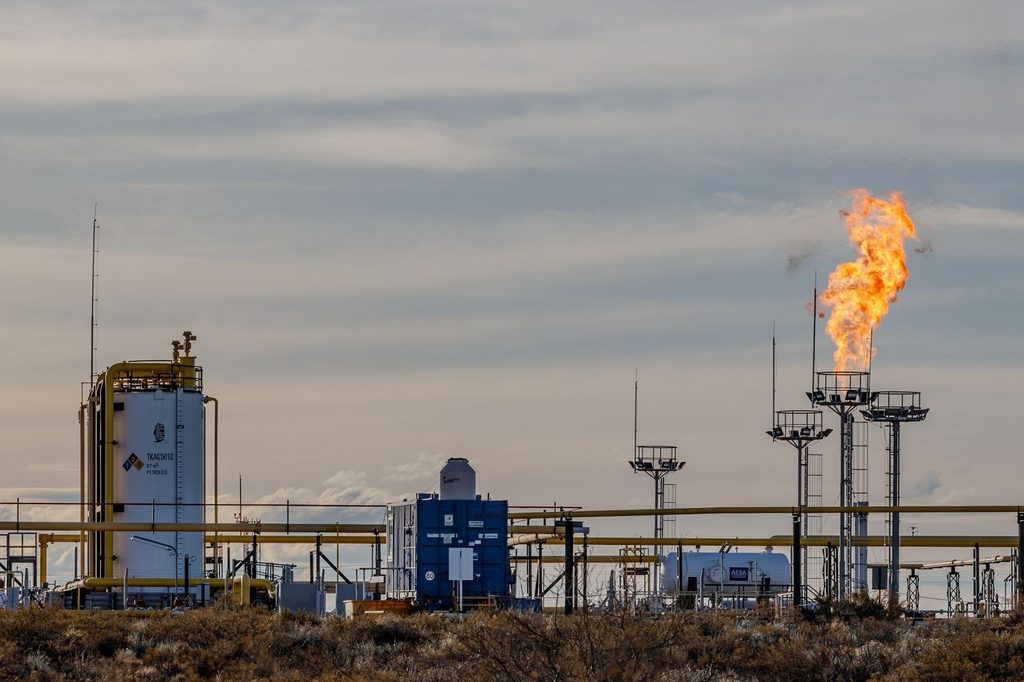
Photo: Martín Álvarez Mullally
Official records also show that the area has a long history of environmental incidents. According to the Neuquén Undersecretariat of Environment’s 2021 Management Report, 49 incidents were recorded in Aguada Toledo and 26 in Loma La Lata during 2019.
Official environmental incident records for the 2017–2021 period also document gas-release events in Aguada Toledo. According to these records, on November 15, 2017, YPF reported an emission of 80,000 cubic meters of gas per day, although the record does not specify how many days the release continued. One week later, the company reported another incident in the same field, involving 13,333 cubic meters of gas.
School No. 291 was left in the middle of Vaca Muerta’s expansion. Around it, an extensive network of hydrocarbon infrastructure has been built, including conventional and fracking wells, gas venting and flaring facilities, processing plants, a compressor station, batteries and pipelines. The scale of this infrastructure, together with the proximity of the methane source to the school, illustrates the extent to which the school has been exposed to hydrocarbon operations.
Ultimately, the School No. 291 community is being displaced from its own territory so that the polluting company can carry out mitigation work. This runs counter to the precautionary principle: the company’s activities should be halted until the provincial government can establish that they are not harming the health of the school community or other residents of the area.
The province has still not provided precise information about the environmental situation in Aguada Toledo. After repeated demands, the school community obtained an internal communication between education authorities, but the document still does not clearly establish the scope of the problem.
Since Monday, classes have been relocated to Challacó, meaning students now spend more than four hours a day traveling. Instead of guaranteeing the right to education under safe conditions and requiring the activities causing the pollution to stop, the State chose to close the school and relocate its community, while leaving environmental studies, monitoring and mitigation work in YPF’s hands.
So far, according to the responses received, neither the Secretariat of Environment nor the Provincial Council of Education plans to assess the possible health consequences of exposure for either the people attending the school or those living in the surrounding area. Markdown pegado