

A court in Neuquén has ordered the COMARSA case to proceed to a public oral trial over the accumulation of more than 300,000 cubic meters of hazardous waste generated by the oil and gas industry, including fracking operations. During the pre-trial hearing, most of the evidence submitted by the Argentine Association of Environmental Lawyers (AAdeAA) was admitted.
The case will be heard by a panel of judges. At the same hearing, the judge dismissed the fraud charge and ruled that he did not have jurisdiction to decide whether the case should be heard by a jury. AAdeAA has been pushing for a jury trial because of the scale of the environmental damage involved and the broader public significance of the case.
The case investigates the illegal accumulation of more than 300,000 cubic meters of hazardous waste produced by the oil and gas industry at COMARSA facilities in the Neuquén Oeste Industrial Park.
Waste generated by hydrocarbon operations was deposited on land without proper impermeable lining. The case examines impacts on the atmosphere and on land located in an area designated for the urban expansion of the city of Neuquén.
This is one of the most serious pollution cases linked to the oil industry in the province’s history. The case brings into public debate a dimension of the Vaca Muerta development that is often overlooked: oil and gas extraction also generates enormous volumes of hazardous waste that must be properly treated and controlled, and whose impacts must be repaired when damage occurs.
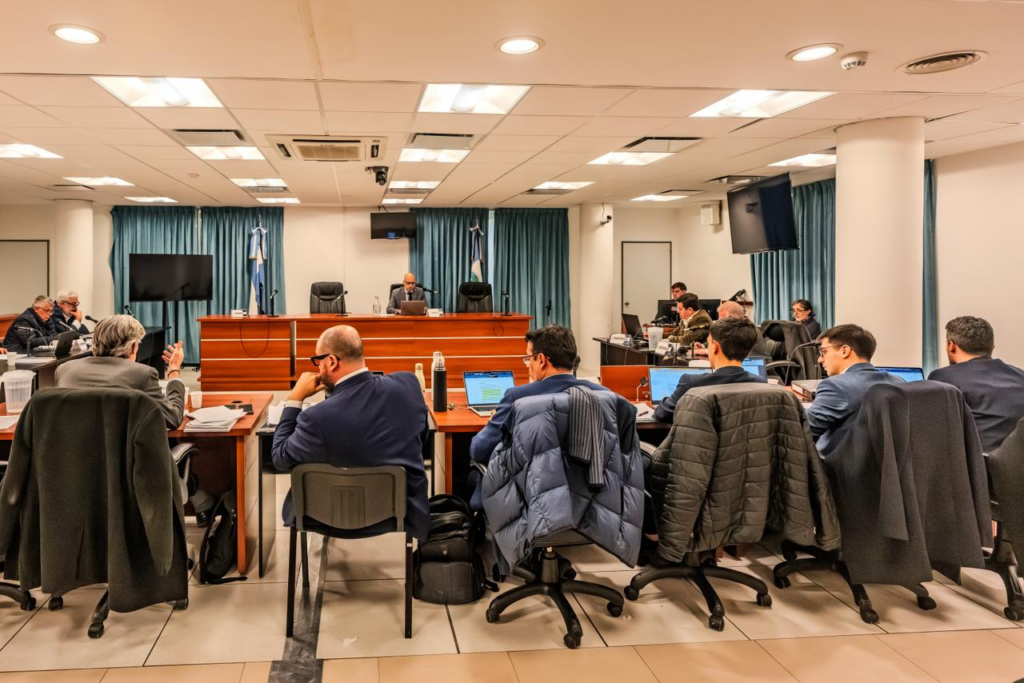
During the pre-trial hearing, the court admitted most of the evidence submitted for the oral proceedings.
Some witnesses were excluded because the court considered their testimony redundant. One piece of evidence was also excluded because professional confidentiality had not been formally waived.
The judge ultimately ordered the case to proceed to a public oral trial before a panel of judges.
At the same time, the court dismissed the fraud charge that had also been under investigation. The case will therefore move forward to trial over the alleged pollution caused by hazardous oil and gas waste.
One of the central arguments put forward by the Argentine Association of Environmental Lawyers is that a case of this magnitude should be decided by a popular jury. The Environment and Natural Resources Foundation (FARN) and the Institute for Comparative Studies in Criminal and Social Sciences (INECIP) were previously admitted by the Superior Court of Justice of Neuquén as amicus curiae, or “friends of the court,” and supported this position.
Both organizations argued that public participation in the administration of justice is particularly important in cases involving collective rights and impacts affecting entire territories. A jury brings a plurality of experiences, perspectives and social backgrounds into proceedings concerning harms that go far beyond a dispute between private parties.
During the hearing, however, the judge stated that he did not have jurisdiction to determine whether the case should proceed before a jury.
The question of who should judge one of Neuquén’s most significant oil pollution cases is itself a central issue. The impacts generated by the hydrocarbon industry affect collective goods and raise questions that directly concern society as a whole: what controls should apply to companies, who is responsible for hazardous waste, and how damaged territories should be repaired.
The COMARSA case exposes a structural problem of the hydrocarbon model: the enormous volume of waste generated by oil and gas extraction.
Drilling muds, drilling cuttings, contaminated soil and other hazardous materials must be transported and treated away from extraction sites. When these systems fail, the costs of the industry remain in the territories in the form of massive oil and gas waste dumps. The upcoming public trial will make it possible to openly examine responsibility for what happened at COMARSA and the scale of the damage caused.
As oil and gas extraction continues to expand in Neuquén, effective oversight, corporate accountability and mechanisms for repairing damage are essential. Vaca Muerta must also be assessed in terms of the waste and damage left behind by extraction.
The Argentine Association of Environmental Lawyers will continue to take part in the proceedings to ensure that responsibility for the pollution is determined and that the damage caused to affected territories does not go unaddressed.
Fotografía: Observatorio Petrolero Sur