
The Argentinea Court of Río Grande granted the interim injunction requested by the Argentine Association of Environmental Lawyers and the Malvinas Islands Ex-Combatants Centre of La Plata. It ordered Rockhopper and Navitas to refrain from commencing or carrying out the oil exploitation works associated with the project known as “León Marino” and to disclose the technical, corporate and financial structure supporting the project.
Tierra del Fuego / Buenos Aires, 16 September 2026.
The Federal Judiciary ordered a halt to the commencement and physical execution of the León Marino oil project, referred to as Sea Lion by the companies, which Rockhopper Exploration and Navitas Petroleum intend to develop on the Argentine continental shelf, approximately 220 kilometres north of the Malvinas Islands. The ruling was issued by the Federal Court of Río Grande within the framework of the collective action for the prevention of environmental harm brought by the Argentine Association of Environmental Lawyers (AAdeAA) and the Malvinas Islands Ex-Combatants Centre of La Plata (CECIM).
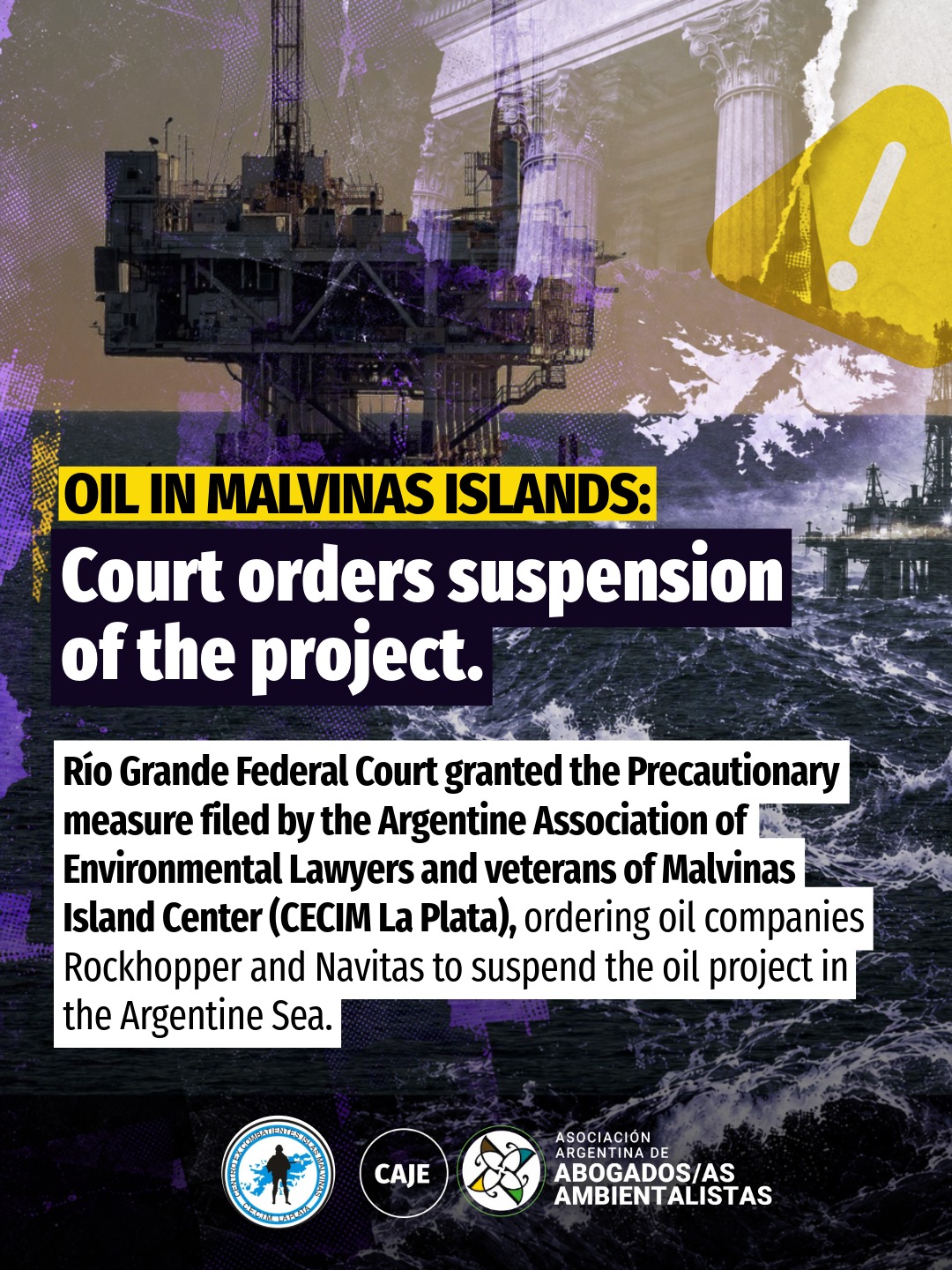
Federal Judge Mariel Borruto granted the interim injunction and ordered the two foreign companies to refrain from commencing, continuing, carrying out or commissioning the physical works required to develop the oil exploitation project. The prohibition covers both offshore operations and the onshore and port infrastructure intended to support the project.
The decision represents a fundamental step forward in the defence of Argentine sovereignty and the protection of South Atlantic ecosystems. Faced with a project promoted under licences issued by the British occupation government, the Court affirmed the application of Argentine law and ordered preventive action before drilling begins and potentially irreversible damage occurs.
The interim injunction prohibits the British company Rockhopper Exploration and the Israeli company Navitas Petroleum Development and Production Limited from proceeding with:
- Drilling into the seabed and marine subsoil for the development or exploitation of hydrocarbons.
- The permanent installation of subsea infrastructure for the extraction or production of oil and gas.
- The installation of pipelines, flowlines, injection, communication and control systems, and permanent mooring structures.
- The installation or commissioning of floating hydrocarbon production, storage and offloading units.
- The commencement of commercial oil and gas extraction or exploitation.
- The onshore and port works intended to support those operations.
The prohibition also covers the expansion of port facilities, the construction or commissioning of logistics bases, drilling mud and cement preparation plants, chemical storage facilities, residential infrastructure and aviation support facilities connected with León Marino.
The order extends to any potential expansion of the project and to any wells or facilities functionally integrated into the undertaking.
The companies must continue to refrain from these activities until the environmental impact assessment procedure required by Argentina’s General Environmental Law has been conducted before the competent Argentine environmental authority and the corresponding decision has been issued, or until the Court rules otherwise.
The project is intended to be developed on the Argentine continental shelf and within Argentine maritime areas. The Court therefore held that its authorisation requirements and environmental safeguards are governed by Argentine law.
The decision also recognises that the environmental regulations and laws governing hydrocarbon exploration and exploitation on the Argentine continental shelf are mandatory, regardless of the companies’ nationalities or any permits they claim to have obtained from authorities other than those of Argentina.
Court orders disclosure of the hidden network behind the project
Rockhopper and Navitas will have ten court days from the date on which they are duly served to submit information and supporting documentation under oath.
The Court ordered them to disclose:
- The current stage of implementation of León Marino.
- The updated schedule for construction, drilling, installation and the commencement of exploitation.
- The number, location and status of the planned wells.
- The planned floating production, storage and offloading units.
- The contracted drilling units.
- The principal contractors and subcontractors involved in drilling, subsea infrastructure, logistics and production.
- The corporate structure used to develop the project and each company’s shareholding.
- The banks, investment funds and other actors that have specifically financed the undertaking.
- The disbursements already made, committed and outstanding.
- The insurers and reinsurers connected with the construction, drilling and exploitation stages.
- The environmental studies and assessments conducted in relation to the project.
- Risk assessments, oil-spill modelling and prevention, contingency and response plans.
- The onshore and port infrastructure already built or planned.
- Any planned expansions and additional wells.
This information will make it possible to determine the project’s true scale and reconstruct the chain of companies, banks, funds, insurers and contractors enabling it to move forward.
Preservation of documents and further proceedings
The ruling also requires the companies to fully preserve all technical, environmental, corporate, contractual, financial and insurance documentation connected with León Marino. The companies must refrain from destroying, altering, concealing or disposing of those documents in any way that could prevent their incorporation into the court proceedings.
The Court temporarily deferred its decision on the requested general prohibition against entering into financing agreements, receiving disbursements, making transfers, establishing guarantees or encumbering assets. Before ruling on those restrictions, it required the precise identification of the actors, transactions and assets involved.
Once that information has been incorporated into the case, the Court may order specific measures concerning financial transactions directly linked to the project. The interim injunction may be maintained, modified, expanded or lifted in light of the new evidence gathered in the proceedings.
The Argentine State must provide and demand information
The Court also ordered urgent requests for information to several Argentine State agencies.
The Environmental Impact Assessment Directorate must report whether any environmental procedure, project notice, environmental impact declaration or environmental clearance certificate exists in connection with León Marino. If such proceedings are initiated in the future, the Directorate must notify the Court.
The Secretariat of Energy must submit the administrative records concerning Rockhopper, Navitas and the other companies linked to the project. It must also report on the current validity and scope of existing sanctions and administrative proceedings.
The Argentine Ministry of Foreign Affairs must specify whether any of the companies, their parent companies, contractors or related entities received authorisation from the Argentine State to conduct hydrocarbon activities in the Malvinas Islands or the surrounding maritime areas. It must also report on investigations, declarations of clandestine activity, disqualifications and sanctions connected with the project.
Environmental sovereignty over the Argentine Sea
León Marino is a large-scale oil exploitation project intended to operate for more than thirty years. Its initial phases include 23 subsea wells, infrastructure installed on the seabed, a floating production and storage unit, and an extensive logistics and port base.
Rockhopper is a British company. Navitas Petroleum is Israeli and controls 65% of the project through a subsidiary incorporated in the United Kingdom. Rockhopper retains the remaining 35%.
The companies intend to proceed under permits granted by the British colonial administration that illegally occupies the Malvinas Islands. The exploitation would turn territorial occupation into the economic appropriation of Argentine natural resources and consolidate foreign oil infrastructure in the South Atlantic for decades.
The project threatens the Argentine Sea and South Atlantic Islands ecoregions. Drilling, underwater noise, the constant movement of vessels, the use of chemical substances, operational discharges and the risk of oil spills could affect feeding, breeding and migration areas used by whales, sea lions, elephant seals, penguins, albatrosses, petrels, fish, sharks, rays and other species.
Territorial sovereignty and comprehensive environmental protection form part of the same defence of our territory, ecosystems and identity. Exercising sovereignty in broad and comprehensive terms means deciding which activities may take place, enforcing Argentine laws and regulations throughout the entire national territory, assessing their consequences and protecting the commons from appropriation by foreign corporations.
The underlying legal action
The joint action brought by CECIM La Plata and the Argentine Association of Environmental Lawyers unites the defence of Argentina’s sovereign rights with the protection of the marine environment. The ruling recognises that the legal action is not limited to a technical or environmental dispute. At the heart of the case lies the defence of Argentine sovereignty over the Malvinas Islands and their maritime areas, together with the obligation to preserve the South Atlantic for present and future generations. At the same time, the global climate crisis makes it increasingly urgent to advance orderly and comprehensive global energy transition processes, including a debate on climate justice for affected territories.
For years, diplomatic declarations and public statements of opposition failed to prevent the companies from continuing their preparations for exploration and exploitation. This interim injunction constitutes concrete action: it orders the works to stop before drilling begins, requires information on the financial and corporate actors behind the project, and opens the possibility of further measures targeting the economic chain driving it forward.
The defence of Malvinas requires long-term public policies and coordinated action by all State institutions. The Federal Judiciary has taken a fundamental step. The ruling must now be effectively enforced to prevent Rockhopper and Navitas from consolidating a foreign oil exploitation project in Argentine maritime territory.
The project must be stopped before oil exploitation begins. Defending the Argentine Sea means exercising sovereignty.